

From a single-story building and four acres of land in downtown Knoxville to 920 acres on the banks of the Tennessee River, UT’s move 200 years ago to the iconic Hill gave the university room to plant academic roots that keep growing.

Blount College
When UT was founded in 1794 as Blount College, it opened its doors on Gay Street in a frame structure that spanned the entire block of what is now the Burwell Building and the Tennessee Theatre.
After a decade and a half of growth, the university was becoming too big for the lone structure and began looking toward the future. The college, which formally adopted the name East Tennessee College in 1809, reached out to President Thomas Jefferson for help in a fund-raising lottery that same year.
While Jefferson vehemently opposed the endorsement of anything related to a decision being made on choice or luck, he did give the university a priceless piece of advice.
In his 1810 response, Jefferson advised the university to adopt his “academical village” idea, moving the institution from a single, multipurposed building to a larger, more spread out area composed of “multiple one- and two-story buildings arranged around a manicured lawn.”
Fifteen years later, Jefferson put the plan into action himself, founding the University of Virginia in Charlottesville.
Heeding Jefferson’s advice, the college bought 40 acres of land in 1826 from Pleasant Moorman Miller for $600. The college then purchased 74 acres of nearby land from Charles McClung Jr. that included his residence, garden, and grounds.

University of Tennessee’s Old College and West College, from University of Tennessee, Knoxville, Special Collections
The first building constructed on the Hill was Old College, a two-story, 10-room structure measuring 65 feet by 50 feet and completed in 1828. The building housed spaces for classes, an observatory, and a belfry tower. Old College’s bell chimed daily for rising, class changes, and lights out.
At first, the building faced criticism from citizens and donors due to the cost and magnitude of the construction. Bricks for the building cost $13 per 1,000, which critics argued cost more than double what they should. In addition to cost, one citizen argued the “monument of folly” mirrored the Tower of Babel.
In 1862 during the Civil War, confederate soldiers utilized the buildings on the Hill as lodging for injured soldiers but left shortly before the Union began its occupation of Knoxville beginning in 1863. Union soldiers then used the buildings as lodging and hospitals, but the natural surroundings were damaged when soldiers chopped down trees for firewood.
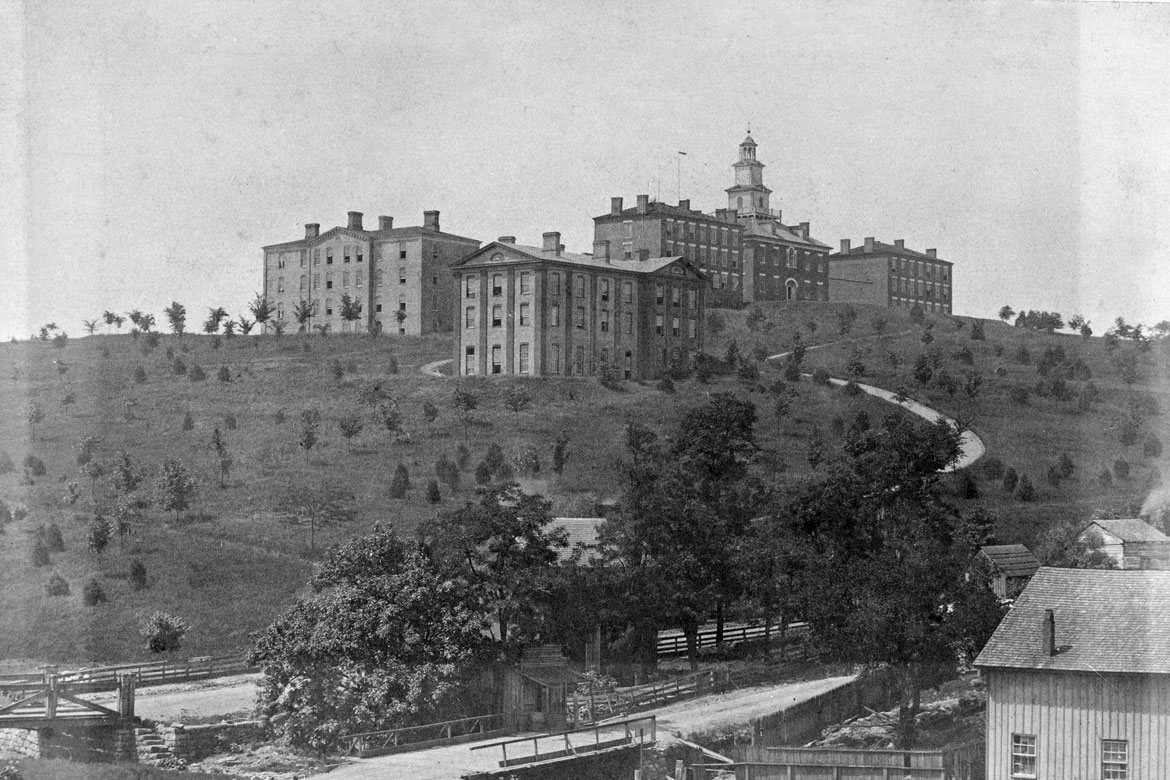
Photograph of the Hill, circa 1877
Once the college reopened, Old College gained a neighbor in South College. Completed in 1872, the four-story dormitory housed 96 men in 24 rooms. Due to additional campus and supportive needs, the building was modified to house two large basement rooms, one of which was used as an armory, as well as a space which would become the first on-campus office for the university president.
As times changed, so did the needs of the university. By 1920, Old College was razed to make room for the building that would become a symbol of the university—Ayres Hall. East College and West College, which had been built in 1842, were also torn down to make room for the new building.
Unlike the other original buildings on the Hill, South College was preserved and still remains on its original site in the southern shadow of Ayres Hall.
Now a campus landmark, Ayres Hall has seen much change since its completion in 1921. Advocacy for development of the building came from then-university President David Ayres, who reasoned that the smaller buildings on the land should give way to “‘one, large crown jewel building on the Hill.”

View of the University of Tennessee’s “Hill,” including Ayres Hall, Science Hall, South College, and Shields-Watkins Field shortly after construction. From University of Tennessee, Knoxville, Special Collections
Ayres Hall was formative to the identity of the university as it is today. Due to the size of the building, 15,000 cubic yards of the Hill were removed to lower the base of the land and used in the construction of Shields-Watkins field. The checkerboard pattern featured on the top of Ayres Hall is now mirrored in the orange-and-white end zones of the field in Neyland Stadium. Additionally, legend has it that the university adopted its signature orange color from the daisies which grew on the Hill.
Today, the Hill is still the academic heart of campus and a place of reverence for students and alumni. And on football game days, the Pride of the Southland Band continues to thrill fans on its march to Neyland Stadium—stopping to perform the Salute to the Hill.
Even as UT changes and grows, the words of the alma mater will continue to ring true:
On a hallowed hill in Tennessee
Like beacon shining bright
The stately walls of old UT
Rise glorious to the sight.”

—
Sources:
Volopedia
Knoxville History Project