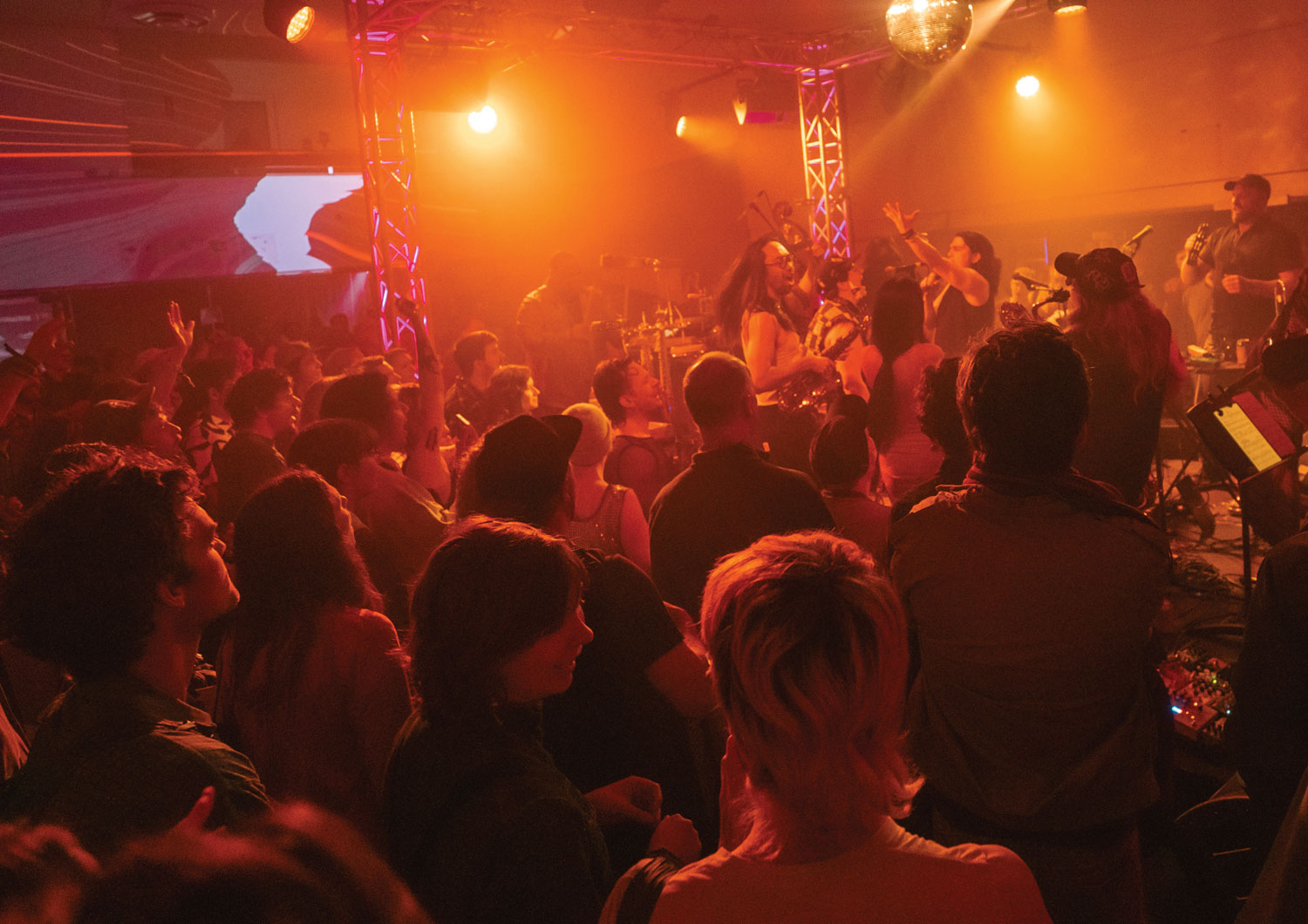
Since its founding in 2009 by Ashley Capps (’79), the Big Ears festival has become one of Knoxville’s signature annual events, known for its eclectic programming and attracting music fans from around the world. But for UT students interested in the hospitality and tourism industry, it also presents a valuable opportunity for real-world experience and relationship building.

Back row (from left): Matthew Glass and Josiah Rushing. Front (from left): Abigail Kelley, Genevieve Bobb, and Lainee Fuentes
This year’s festival marked the fourth year of a partnership with UT’s Department of Retail, Hospitality, and Tourism Management to give students hands-on experience working behind the scenes of a large cultural event. Six students worked as ambassadors, performing a variety of essential tasks to help keep the event running smoothly.
Juniors Josiah Rushing and Matthew Glass were two of the ambassadors responsible for organizing, packing, and delivering supplies to multiple venues. Throughout Big Ears, they worked to replenish supplies, often adjusting plans on the fly to meet day-to-day operational needs and artist requests. The students say working closely with event and venue staff sharpened their communication and teamwork skills while showing them how to navigate a high-pressure environment.
“At a music festival like that, where there’s so much going on, it could be overwhelming for anyone,” says Glass, a hospitality and tourism management major from Nashville who has previous experience working at banquets and other events at a hotel. “Something could have gone wrong 90 seconds before we got there, so for us to stay levelheaded helped everyone.”
Rushing, a public relations major from Sparta, Tennessee, with a minor in corporate event production strategy and design, learned the value of understanding staff dynamics in a people-centered industry.
“It’s important to remember that everyone has their own problems, and they might be stressed,” he says. “Just as we’re trying to do our job, they’re trying to do theirs, so you need to be gracious with other people because you never really know what they’re going through.”
I’m so thankful we got to be a part of this experience. It’s helped me imagine a life in Knoxville even after graduation because it’s really a special town with a lot of special places and people. It’s made me more grateful than ever that I go to school here.”
—Josiah Rushing
Even before working with Big Ears, Rushing had gained experience through the LEO Events Fellows Program, an experiential apprenticeship program associated with his minor. He says that program—coupled with working at Chattanooga’s Moon River Festival through the College of Communication and Information’s Moon River U as well as interning at Bonnaroo and Lollapalooza—helped him understand important guiding principles of event work, including how to get his job done without being the center of attention.
“Knowing when is a good time to insert myself into a conversation and when is not—I can directly attribute that to my LEO Fellows experience, which is an opportunity UT gave me,” he says.
Maintaining a positive professional rapport in industry-facing roles is especially important for Big Ears ambassadors, since building relationships and connections is a key component of the program. Networking opportunities began the Monday before the festival, when event organizers hosted a welcome dinner where the students had the chance to meet industry professionals and learn about their work.

Tennessee Theatre marquee for Big Ears Festival. Photo by Ashli Linkous
“Many of the staff who come in for execution of the events work on other major festivals and events across the country—therefore, the network is huge,” says RHTM Senior Coordinator Christopher Kelley, who serves as the primary advisor for all hospitality and tourism management majors and recruited the ambassadors for this year’s festival.
Rushing says he made connections that could lead to potential future opportunities in Knoxville’s music scene and gained valuable practice learning how to advocate for himself while still maintaining appropriate boundaries.
“Asking people what they do, asking them to write letters of recommendation, asking them about internships—things like that are opportunities that I just would not have gotten without being in this program,” he says. “It’s important to not be a nuisance or disrespectful, but if we’re not getting networking experience, we’re doing this wrong.”
Glass agrees. “Making connections is how you truly get the most out of it,” he says. “At the festival, you run into people who can help you out in your career, so you have to get to know them and be confident enough to sell yourself as someone they can trust and believe in.”
Big Ears Ambassadors build that trust by making a real-world impact at the festival. Kelley says event organizers have praised the ambassadors as vital to the event’s hospitality efforts, daily logistics, and venue coordination, commending the students for their efficiency, insightful questions, and eagerness to help.

Matthew Glass and Josiah Rushing unload a truck.
For Glass and Rushing, the hard work paid off in ways they couldn’t have experienced as typical attendees—from witnessing a band’s moving preshow ritual backstage to spotting the supplies they’d delivered being used during musicians’ sets. After putting in demanding days on the job, they were able to enjoy shows in the evenings and follow their curiosity about unfamiliar performers.
“Big Ears is such a music discovery festival,” Rushing says. “It was really fun getting to explore.”
The ambassador program gives students the chance to discover new ideas about their careers as well. Glass says before the Big Ears opportunity presented itself, he hadn’t thought about a career in the music festival industry, but now he sees the potential for his personal interest in music and his professional interest in hospitality to intertwine.
“Festivals are like their own little world, and that’s the type of work I enjoy—almost like escaping to a different place for a little bit and fully being in that bubble while I’m there,” Glass says. “Being downtown 14 hours a day made me feel like I was in a new city, even though I’ve lived here for three years. Big Ears made it all feel new again.”
Rushing also gained a new appreciation for UT and Knoxville thanks to the ambassador program.
“I’m so thankful we got to be a part of this experience,” he says. “It’s helped me imagine a life in Knoxville even after graduation because it’s really a special town with a lot of special places and people. It’s made me more grateful than ever that I go to school here.”
—
Top image: Arthur Russell concert at the 2026 Big Ears Festival. Photo by Tarryn Ferro
Writing About Big Ears
Distinguished Professor of English Urmila Seshagiri teaches an interdisciplinary class for musically adventurous students that gives them a deep dive into the unparalleled experience of Big Ears. Students in English 475 immerse themselves in the Big Ears world of music, art, film, and poetry and then have the chance to attend the four-day festival thanks to a scholarship funded by festival fans Patti and John Haslett.

Students in English 475 attend the Big Ears Festival.
In class, they read a rich variety of historical and literary source materials such as overviews of early blues music and fiction by authors like James Baldwin and Salman Rushdie. They watch documentaries about the history of jazz, the global journey of the banjo, and biographies of individual artists. Festival insiders like founder and UT alumnus Ashley Capps visit the class to share insights. Students carry their research into their Big Ears experience and then write a formal research paper on their chosen performer, plus a second paper reflecting on what the festival means for their UT education and how it impacts other aspects of their lives.
—Randall Brown