

It’s the kind of moment a literary researcher dreams of. After waiting years to view a document, you finally hold it in your hands—and realize it’s much more important than you’d imagined.
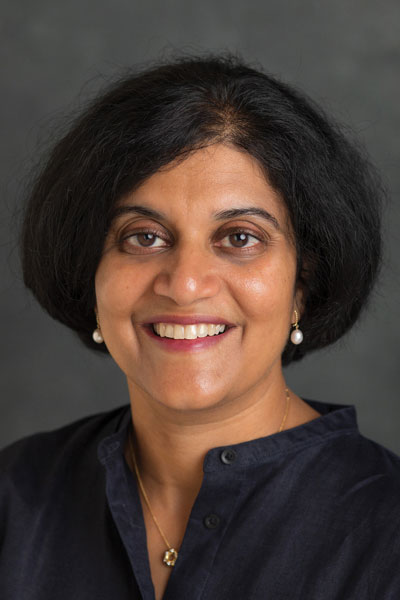
Urmila Seshagiri
For Distinguished Professor in Humanities and Professor of English Urmila Seshagiri, the document was a previously undiscovered early work of Virginia Woolf, one of the most influential writers of the 20th century. And the setting of her discovery was equally dreamlike: a reading room at Longleat, a spectacular historic estate house in southwest England.
Composed of three comic fantasies that form a mock biography of Woolf’s mentor and close friend Violet Mary Dickinson, the work dates to 1907—eight years before Woolf published her first novel. As she read through the stories, Seshagiri realized that they introduce many of the themes and techniques Woolf developed in her later work. Equally important, they show a different side of the author—one filled with humor and fantasy. “They are so wonderful and funny and unexpected,” says Seshagiri.
She first learned of the manuscript’s existence in 2018 while researching Woolf’s autobiographical work A Sketch of the Past. A letter from Woolf to Dickinson referred to a family memoir Dickinson had written, and a suggestion from a librarian at the University of Sussex led Seshagiri to contact Longleat House, whose archives include Dickinson’s papers. The archivist at Longleat confirmed that they had the Dickinson memoir and mentioned that they also had a manuscript by Woolf, “Friendships Gallery.”
Up to that point, the only known copy of “Friendships Gallery” was an incomplete early draft in the New York Public Library, long disregarded as an insignificant sketch. The news of a second version was exciting, but there was no way of knowing how much—if at all—it differed from the draft in New York without viewing the work for herself. And that, it turned out, would take four long years.
“The years that passed between my learning of the existence of that typescript and my being able to see it—those four years—that was so difficult. Curiosity, and impatience to know whether it was simply a duplicate of something that we knew or if it was actually a different text, was the hardest part,” she says.
Much of the delay was due to the pandemic, but there were other complications as well, she explains. “Going through the chain of command to be allowed access into Longleat House, into the archives—that was the most challenging part of it. It was a lesson in persisting.”
Seshagiri’s impressive academic credentials in the field were undoubtedly an asset in opening those doors. She had already edited a new edition of Jacob’s Room, Woolf’s third novel, for the Oxford University Press, contributed chapters to both The Oxford Handbook to Virginia Woolf and The Cambridge Companion to Virginia Woolf’s To The Lighthouse, and published numerous articles on Woolf and other modernist writers in prestigious journals.
As an undergraduate at Oberlin College, Seshagiri had started out studying Shakespeare. She became interested in modernism during her time at the University of Illinois, Urbana-Champaign, where she completed both her master’s degree and her PhD. “I leaped forward 300 years in time. I began reading a lot of fiction from the early 20th century, and that was when I decided I wanted to be a scholar of that era,” she says.
Her interest in language and literature, however, were there from the beginning. “From the time I was very, very little, I gravitated towards questions about language. I was a writer, I was a violinist, I grew up in a bilingual household, I lived overseas in Hong Kong. I always felt that language was the most essential part of human DNA, and literature was the expression of language that moved me most deeply,” she recalls.
Seshagiri’s persistence in pursuing the manuscript eventually paid off, and she was able to travel to Longleat and view it. Exciting as the discovery was, it turned out to be the beginning of another three-year process: preparing the work for publication. In addition to obtaining the necessary permissions and transcribing the manuscript itself, she compiled detailed explanatory notes, a bibliography, and a character-by-character analysis comparing the Longleat version to the earlier draft at the New York Public Library. She wrote a preface that recounts the remarkable story of the manuscript’s discovery and a 40-page afterword establishing the place of The Life of Violet, as Seshagiri titled the stories, within Woolf’s body of work.
For Seshagiri, the process was labor intensive and thrilling. “You have to sustain monomaniacal focus on the text. You wind up spending a lot of time thinking about each comma,” she says. “But then you also have this wonderful discovery of new work by a writer who is beloved by so many readers, and you want to really balance those two things as you put it together. So the work of putting it together was very painstaking, and it had to be very, very precise. But my behind-the-scenes precision was in the service of letting Woolf’s spirit and imagination become visible to the reader.”
The process gave important experience to the students who served as Seshagiri’s research assistants: doctoral student Kathryn Bradshaw, now at the University of Southern California, and undergraduate Izzy Alexander (’25), who is pursuing a master’s degree in English at UT.
Seshagiri says the students were invaluable as extra eyes, helping to ensure that her work was consistent and correct, and provided points of discussion as some of the first readers of the work. “I think it was an excellent experience,” she says. “They got to do some textual work; they got to work with preparation for publication with a top press.”
She is quick to credit the university’s role in making the project possible, particularly in providing the funding for two trips to the United Kingdom—one to view the manuscript and another during the preparations for publication. The book’s acknowledgements cite support from the Department of English, the College of Arts and Sciences, UT’s Denbo Center for Humanities and the Arts, and the Office of Research, Innovation, and Economic Development.
“I could not have done this without the support I had from UT,” she says, adding, “This is the kind of support that work in the humanities needs. And to be able to travel, to be able to teach graduate seminars on Woolf and modernism and share this work with a rising generation of scholars as it’s taking shape, is one of the great privileges of a research university.”
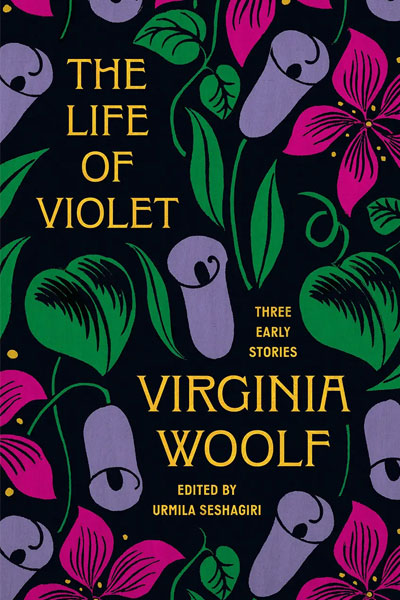
Cover of The Life of Violet
The Life of Violet: Three Early Stories was published in October 2025 by Princeton University Press, meeting with scholarly acclaim and delight from Woolf’s fans around the world. It received widespread media coverage including features by the BBC, PBS News Hour, The Washington Post, The Sunday Times (London), The Guardian, and international editions of Vogue. A Spanish translation was published in early May, and six more translations—into Arabic, French, German, Korean, Norwegian, and Polish—are forthcoming.
Seshagiri has also enjoyed connecting with readers closer to home, with presentations at Knoxville’s Union Avenue Books, local book clubs, and UT’s Seniors for Creative Learning program.
In June, she’ll travel to Istanbul to present a featured session at the 35th Annual International Conference on Virginia Woolf and then to England for events in Oxford and London.
Meanwhile, Seshagiri is completing the first scholarly edition of A Sketch of the Past—the project she was researching when she discovered the manuscript at Longleat—and the Norton Library’s 100th anniversary edition of Woolf’s To the Lighthouse, both being published later this year.
With the two new publications, Seshagiri’s work draws an arc through Woolf’s entire career, from her earliest work in Violet to her first experimental novel in Jacob’s Ladder, her masterpiece To the Lighthouse, and her final work, A Sketch of the Past. It’s a rare accomplishment for a researcher to achieve that scope of work on a major author.
“I’m very happy it worked out that way,” she says.
—
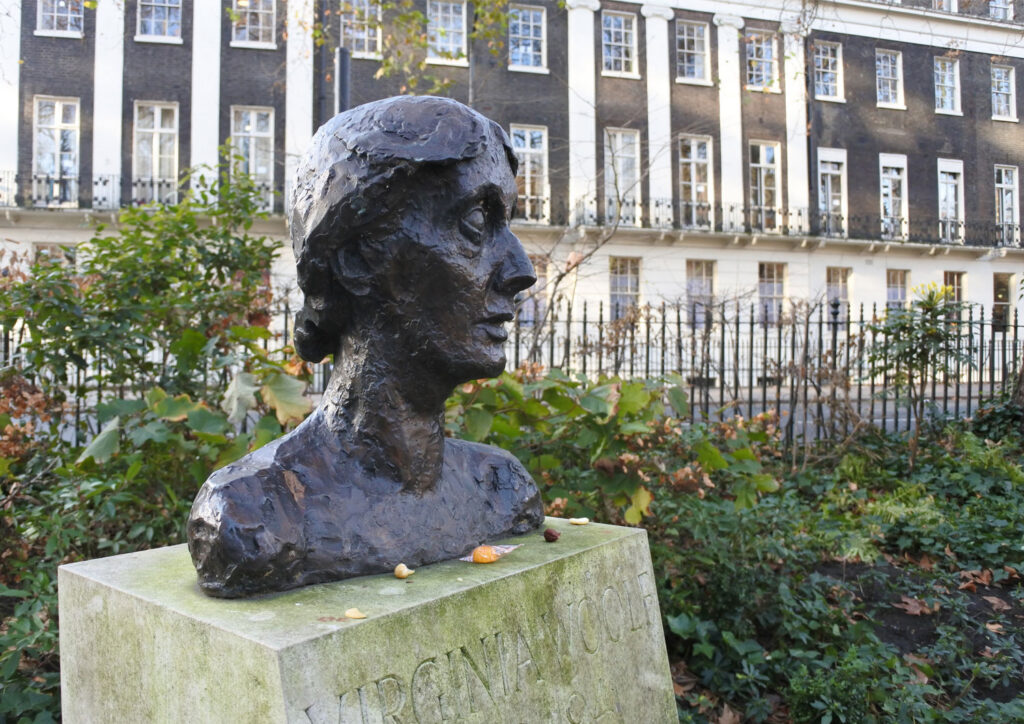
Illustration of Longleat Manor and photos of Virginia Woolf from Wikimedia Commons