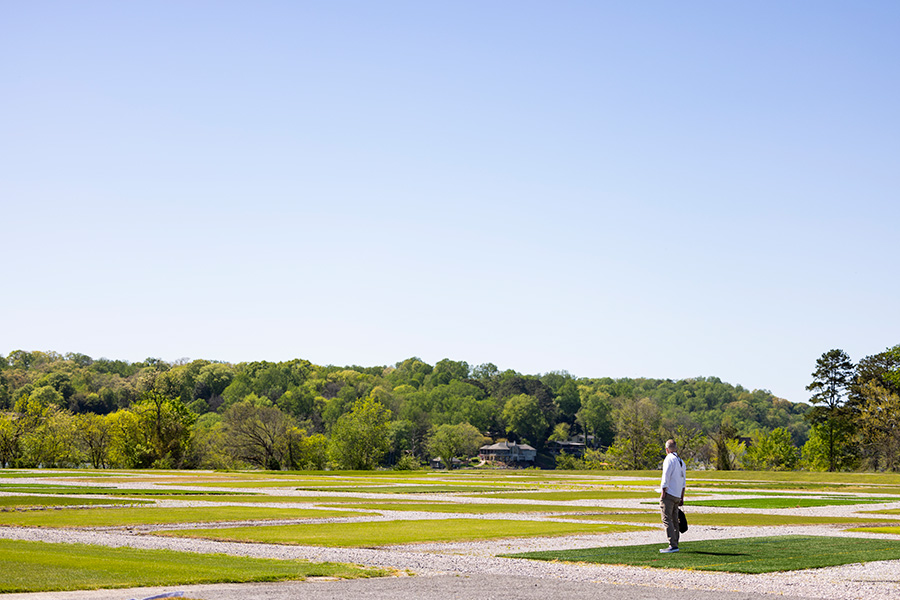

The biggest sporting spectacle in the world was coming to the United States for the first time, and John Stier knew the margin for error was thinner than, well, a blade of grass. With less than a year until the 1994 FIFA Men’s World Cup, the showcase event in global soccer, Stier was a key player on a research team charged with a daunting task: building and installing the first natural grass field in a domed stadium, the Pontiac Silverdome, which would be hosting four games in the World Cup.
Stier and two colleagues were grappling with an array of challenges, scientific and logistical. Nearby, several undergraduate turf science students Stier had hired were hauling sod and shoveling soil. One of the students overheard the discussion and offered a couple of suggestions.
“His epiphany was finding a way to quickly and efficiently lay out an orderly process to assemble and transport the field,” says Stier, who is now the associate dean of the UT’s Herbert College of Agriculture. “We looked at each other and said, ‘That would work.’ We started paying a lot more attention to that student.”
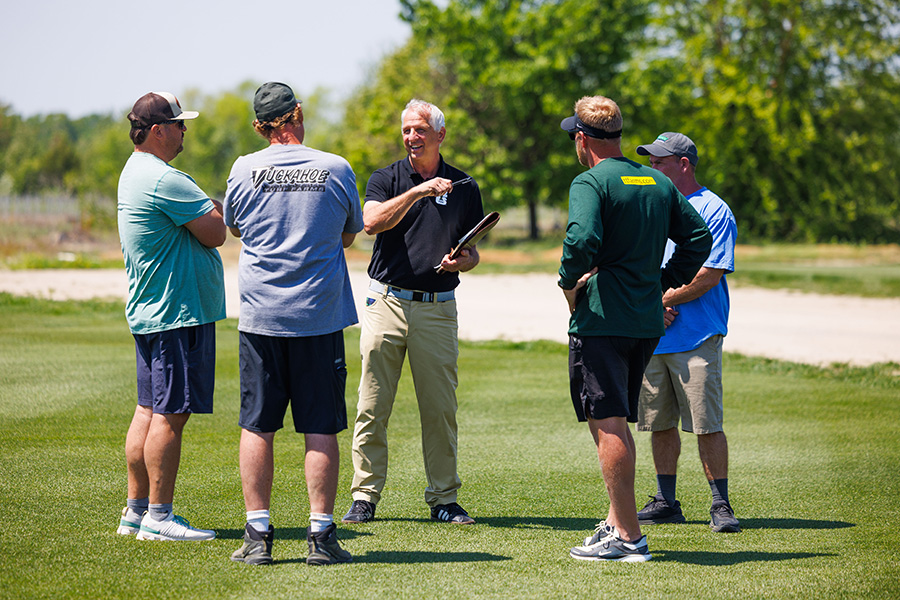
The student’s name was John Sorochan. And more than three decades later, the attention he commands is on a global scale. Distinguished Professor of Turfgrass Science and Management at UT, the 55-year-old Sorochan is leading a team of researchers tasked with bringing state-of-the-art science to the design, installation, and management of the 16 playing surfaces (and scores of training fields) where the FIFA World Cup 26™ will be contested across Canada, Mexico, and the United States.
John is at the forefront of testing and technology in the turf industry. … FIFA made an inspired choice when it chose John to lead their World Cup research initiative. —Paul Ashcroft, Arsenal FC
Launched in 2022 by the Pitch Management Team for FIFA, soccer’s international governing body, it is an unprecedented five-year program to ensure that all of the World Cup 26 matches will be played on the best, safest, and most consistent turfgrass surfaces possible, whether the venue is in the mountains of Mexico, the marshlands of north New Jersey, or the natural splendor of British Columbia.
Five of the stadiums are domed. Eight others require laying the new field over an artificial surface. Climatic differences call for different kinds of grass that require changes in irrigation and maintenance methods. The variables are staggering, but the evidence suggests that FIFA has the right researcher at the helm. By his own admission, Sorochan is a perfectionist when it comes to turfgrass.
“It’s a living organism that is subject to lots of different stresses—water, heat, and traffic,” Sorochan says. “The goal is always to get it back to perfection.”
And no shortcuts are taken in that pursuit, according to Kyley Dickson (’12), who has worked closely with Sorochan for seven years and is associate director of UT’s Center for Athletic Field Safety.
“Nobody has done the amount of research into turfgrass that Dr. Sorochan has,” Dickson says. “He’s a visionary who is always looking five or 10 years ahead. He has very big dreams and isn’t afraid to go after them.”
Paul Ashcroft, the head of horticulture and playing surface operations for Arsenal F.C. in the English Premier League, has been a friend and professional colleague of Sorochan’s for more than 15 years.
“John is at the forefront of testing and technology in the turf industry,” Ashcroft says. “He unites his extensive knowledge of everything from turf maintenance to player-surface biomechanics to such a depth that it empowers grounds managers with detailed and, most importantly, relatable information. FIFA made an inspired choice when it chose John to lead their World Cup research initiative.”
Planting the Seeds
Born and raised in Calgary, Alberta, Sorochan was the youngest of four children, a smart, high-energy kid who played nearly every sport imaginable and envisioned a future as a wide receiver for the Calgary Stampeders in the Canadian Football League. When football didn’t work out, he figured he might go into the family funeral home business or perhaps get a law degree and work in the oil and gas industry. That was his plan when he enrolled at the University of Calgary, studying politics and geology. It didn’t last long, which was a good thing.
“I have a terrible poker face to be an effective lawyer,” Sorochan says, smiling.
Within days of graduating from high school, Sorochan and a friend went backpacking in Europe, traveling to southern Spain to visit a man named Craig Ewanchuk. A former student in Michigan State University’s turfgrass program, Ewanchuk was a Calgary neighbor of Sorochan’s and 12 years his senior. He was in Spain to help famed golf course designer Robert Trent Jones design a course. Sorochan was smitten by the beauty of the landscape and the adventurous life Ewanchuk was leading, traveling the world to bring golf courses to life.
“John said, ‘I want to do what you do,’” Ewanchuk says. “It was like Take Your Younger Brother to Work Day.”
Upon his return home, Sorochan set forth on his new career path. He got a job working the grounds at a golf course and transferred to MSU to study turfgrass.
He likely would have stayed with golf had he not had the opportunity to work on the Silverdome turfgrass installation, a project led by MSU professor John “Trey” Rogers III. A highly respected turfgrass authority, Rogers found out that Sorochan was eager to work on the project and connected him with Stier, who figured he could use all the help he could get and added Sorochan to his work crew.
Now, nine World Cups later, in symmetry as perfect as a lovingly manicured soccer pitch, Rogers and his MSU team are supporting Sorochan’s UT research team to create 16 pitches worthy of the world-class footballers who will be competing in the planet’s grandest and most-watched sporting event of 2026.


Finding His Place
It was shortly after the great Silverdome grass experiment proved to be a rousing success that Sorochan had what he calls “my aha moment.”
He and a few others who had worked on the Silverdome were on the building’s sprawling and pillowy roof, bouncing up and down 400 feet over Pontiac, Michigan, as if it were the world’s biggest trampoline. The roof had small vent holes that allowed you to look down at the field. Sorochan was fascinated by the field’s rectangular majesty but even more so by the wear patterns and spots where it hadn’t held up quite as well.
How can I make this better? he asked himself. What can I do to create the safest, most perfect field possible? Still an undergraduate, Sorochan decided there on the Silverdome roof that he would go on to graduate school to deepen his study of turfgrass.
Sorochan’s expertise has earned him almost enough awards to fill one of the orange-and-white checkered end zones in UT’s Neyland Stadium. Last November, he and five of his faculty colleagues in the UT Institute of Agriculture were recipients of the Excellence in Extension Team Award. The honor was given by the National Institute of Food and Agriculture and the Association of Public and Land-grant Universities in appreciation of their Extension research, technical assistance, and outreach education.
Earlier last year, Sorochan and Dickson received one of UT’s inaugural Chancellor’s Innovation Fund awards for their invention of a testing device called fLEX, which simulates an athlete’s foot strike and offers a way to measure the performance and playability of natural turfgrass surfaces.
These and a bundle of other honors have propelled the university to the forefront of turfgrass scholarship worldwide, with a mission that not only encompasses building top-quality pitches for the World Cup but also seeks to make turfgrass fields safer across numerous sports and recreational applications.
Sorochan says his arrival at UT was pure serendipity. In November 2001 he was presenting his PhD research at a professional meeting. Coleman Ward, a turfgrass professor at Auburn University, told Sorochan he thought he’d be a great fit for a faculty opening at UT. Sorochan found the job posting and, as chance would have it, he was about to travel to East Tennessee to spend Thanksgiving with his future in-laws.
He reached out to Bob Trigiano, who was leading the search for UT, mentioning that he would be passing through the area the following week and asking if he could stop by to discuss the position.
The visit went splendidly. Sorochan submitted his application packet the day before Thanksgiving, and a few weeks later he had his official interview. Neal Rhodes, interim head of UT’s Department of Plant Sciences and Landscape Systems (now the Department of Plant Sciences), offered him the job. Sorochan jokes that it was a positive omen that UT had crushed MSU’s fiercest rival, the University of Michigan, in a bowl game just two days before the job offer came.
I don’t consider it a job. It’s a passion. It’s something I love to do. I get to wake up every day and think, Wow, this is pretty cool. —John Sorochan
As much as Sorochan’s technical knowledge is at the core of this effort, people closest to him will tell you his greatest gifts go well beyond his research expertise. Stier praises Sorochan for his humility and selflessness and a warm, collegial demeanor that enables him to collect very good people around him. Indeed, Sorochan gets more excited talking about the achievements of his students, two of whom are working for FIFA, than he does about his own.
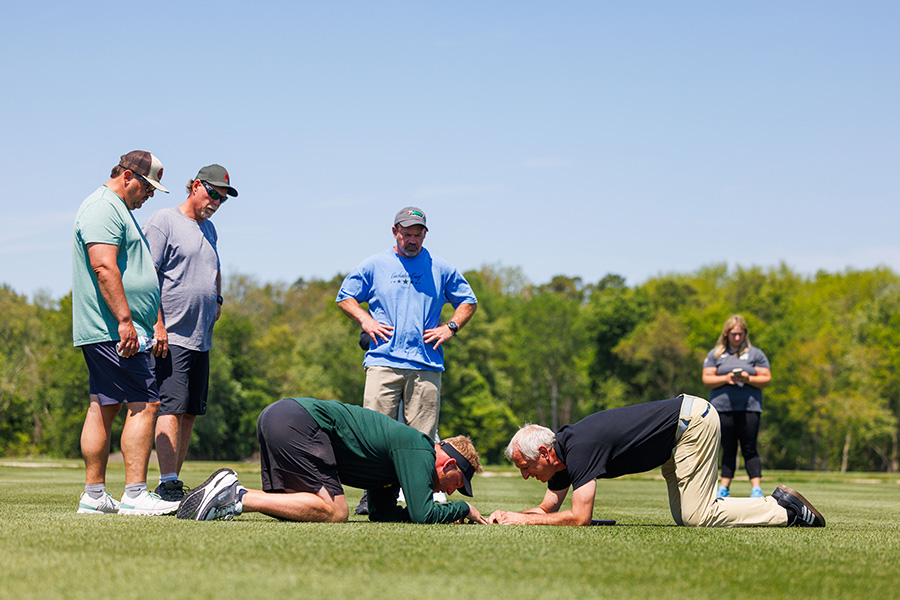
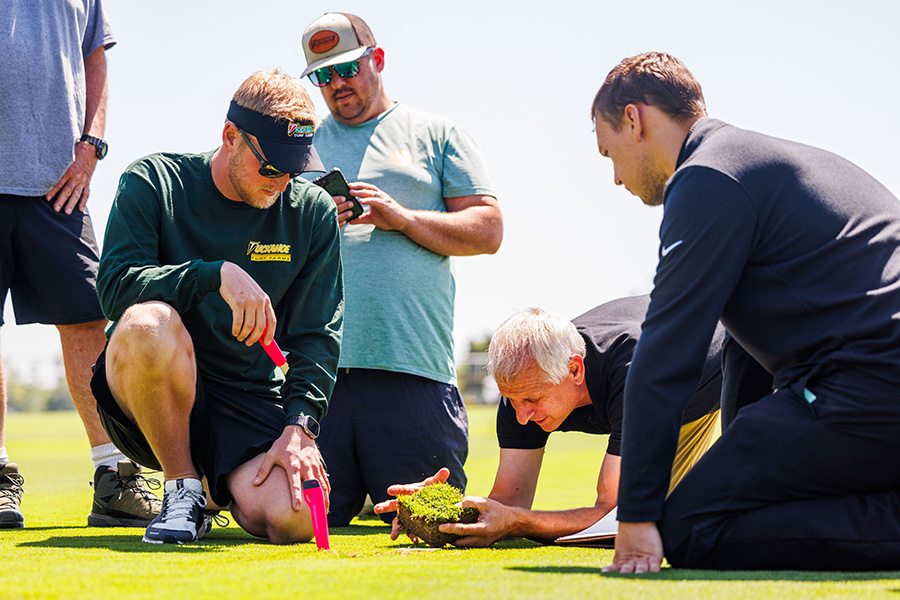
“Since the [FIFA] project began, we’ve run 170 different experiments—very applied experiments to answer discrete problems,” Stier says. “That’s a tribute to the people John has surrounded himself with.”
Several years ago, Dickson’s daughter was born eight weeks premature, weighing just over four pounds. From the start, Sorochan’s message to Dickson never wavered: “Don’t worry about anything. We’ll handle it. Do what you need to do for your family, and we’ll worry about the work.”
“He went above and beyond to find out how my wife and daughter were doing,” Dickson says. “He always wants to make sure his colleagues are taken care of.”
When Dickson returned to work, Sorochan’s leadership style remained unchanged, lifting up his co-workers, unstintingly generous with his praise. “I’ve never gotten so much credit for things in my life,” Dickson says with a small laugh.
This is how it should be, in Sorochan’s view.
“I’m getting a lot of attention—it’s not me, it’s everybody,” he says. “It’s absolutely everybody that’s part of this project. I would be nowhere if it wasn’t for the students and the technicians and my colleagues.”
Sorochan also credits his wife, Lisa, with supporting his life’s work. “She mostly sacrificed everything for me to get to where I am,” he says.
The couple met at a popular MSU hangout in East Lansing, Michigan. Lisa has a master’s degree in turf science as well as a BA in English.
“John is always so quick to credit other people, but because I stayed at home, he had to work extra hard to support that,” says Lisa. “So I am incredibly proud of where he is and the things that he has accomplished, but those pale in comparison to him as a man, a father, and a husband.”
Apart from turfgrass and travel—Sorochan has been to 39 countries, and he and Lisa and their two sons have a particular affinity for Spain—his hobbies include a collection of hummingbird feeders and an elaborate Charles Dickens Christmas village he painstakingly sets up every holiday season.
“I won’t let anyone help me set it up and am very particular about where things go,” Sorochan says.
Lisa confirms this (“He’s very meticulous about his village”) but understands that it is precisely this sort of dedication and attention to detail that make her husband one of the most acclaimed turfgrass scientists in the world.
Thirty-two years after his revelation on the Silverdome roof, Sorochan is grateful that he opted not to devote his life to legal work for gas and oil companies. He’s a turfgrass man, and the roots run deep.
“I don’t consider it a job,” Sorochan says. “It’s a passion. It’s something I love to do. I get to wake up every day and think, Wow, this is pretty cool.”